
What is the Ren’Py Info Stealer Malware? And How Does It Breach Personal and Corporate Networks?
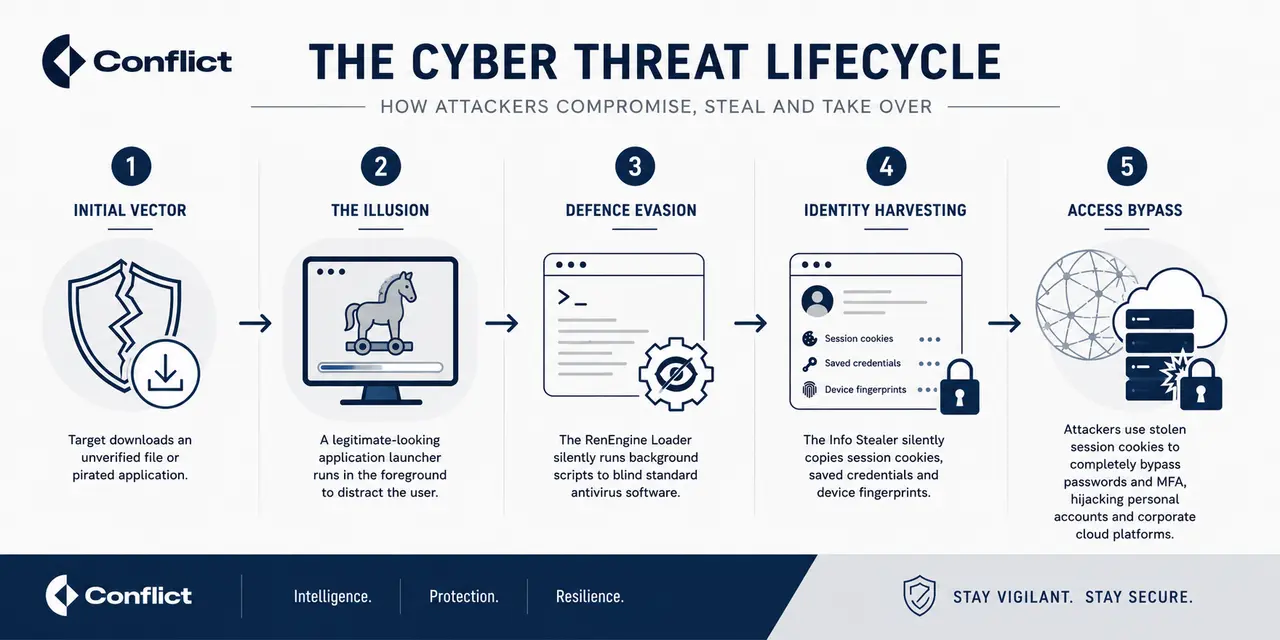
The digital threat landscape has undergone a quiet, insidious transformation. Cybercriminals are moving away from loud ransomware attacks in favour of stealthy, invisible data-harvesting tools known as Info Stealers.
Global threat intelligence data reveals a massive malware campaign utilising a sophisticated dual-stage threat known as the RenEngine Loader—frequently dubbed the "Ren'Py virus" by victims. This single campaign has compromised over 400,000 devices globally, infecting upwards of 5,000 new targets every day.
At Conflict International, our digital forensics teams have seen firsthand how this malware tears through personal lives and corporate networks alike. Whether an individual is downloading software for personal entertainment at home or an employee is running a file on an enterprise asset, the outcome is identical: international fraud syndicates are handed the master keys to the victim's entire digital existence.
Myth vs. Reality: The "Ren’Py" Deception
To protect your data, it is critical to separate the weapon from the vehicle. The phrase "Ren’Py virus" is technically a misnomer.
Ren’Py is a legitimate, widely respected, open-source engine used by independent developers to create visual novels and life simulation games (such as the viral hit Doki Doki Literature Club!). The engine relies on standard Python code and is entirely safe in its official state.
The actual threat arises because sophisticated hacking networks use the trusted Ren’Py framework as a Trojan horse. By taking functional, pirated versions of mainstream software or commercial games (ranging from popular titles like Far Cry and FIFA to design tools like CorelDRAW) and packing them into a modified Ren’Py launcher, attackers exploit the implicit trust users place in the application.
Anatomy of the Attack: From a "Free" Download to Total Asset Drain
The modern info stealer campaign operates with industrialised efficiency, moving systematically from initial exposure to financial and identity liquidation.
1. The Lure
Threat actors upload modified, cracked, or pirated game installers and utility software to unauthorised file-sharing platforms, third-party repositories, or peer-to-peer torrent networks. They use search engine optimisation (SEO) poisoning to ensure their malicious links appear at the top of search queries when users look for "free software mods" or "unlicensed downloads."
2. The Functional Illusion
When a user executes the installer, it spawns a legitimate, working Ren’Py launcher interface. A loading bar typically appears on screen, stopping at 100% or simulating an endless initial setup. While the user assumes the game has simply glitched or frozen, the back-end architecture executes a hidden Python initialisation script (frequently nested inside the script.rpy or archive.rpa system files).
3. Bypassing Defences via the RenEngine Loader
The malicious Python code deploys the RenEngine Loader, which drops a second-stage utility called HijackLoader. This utility is highly evasive, executing sophisticated code modules designed to run anti-virtual machine (VM) checks and side-load malicious files. By piggybacking on a trusted engine like Ren'Py, the malware closely mimics normal application behaviour, successfully blinding standard antivirus controls.
4. The Final Payload: Session Cookie & Identity Theft
Once defences are lowered, the loader deploys an elite information stealer—most commonly from the ACR Stealer, Lumma C2, or Rhadamanthys families. Instead of damaging files or demanding an upfront ransom, the info stealer silently strips the machine of specific, high-value data blocks:
- Session Cookies & OAuth Tokens: This is the most dangerous capability of a modern info stealer. If you log into your personal banking, social media, or corporate cloud and select "Remember Me," an active session token is generated. The info stealer copies this token. By injecting it into an external browser, attackers bypass passwords and Multifactor Authentication (MFA) entirely. To the platform, the hacker looks like you simply continuing your online session.
- Saved Web Credentials: The malware systematically scrapes every username and password saved within Google Chrome, Microsoft Edge, Safari, or Firefox.
- Cryptocurrency Wallets: The stealer scans local drives for browser-extension hot wallets (like MetaMask) and extracts private seed phrases.
- Clipboard Monitoring: It continuously logs the device's clipboard contents, hunting for copied text strings containing security pins, banking credentials, or personal messages.
The Devastating Impact on Personal and Professional Life
Because info stealers operate in complete silence, victims rarely realize they have been breached until the damage is already done. The fallout spans across both personal and professional perimeters:
In Personal Life:
- Financial Fraud: Attackers use stolen credentials to drain personal checking accounts, execute unauthorised credit card transactions, and empty digital asset portfolios.
- Identity Theft & Account Hijacking: Victims are suddenly locked out of their personal Google, Apple, or Microsoft accounts.
- Social Engineering Exploitation: Once the hackers control your personal Discord, Instagram, or email, they begin autonomously broadcasting crypto scams and malicious links to your friends, family, and contacts, leveraging your personal relationships to find new victims.
In Corporate Networks:
- Malware-Free Corporate Breaches: If an employee uses a compromised personal computer to check their corporate email or Slack, the info stealer snatches the corporate session cookie. A ransomware group or corporate spy can buy that single login token on a dark web market for less than $50, log directly into the enterprise cloud, and steal corporate secrets from the inside without ever triggering a malware alert.
Crisis Management: Immediate Response Protocol
If you suspect a device in your home or organisation has interacted with a compromised installer, immediate, process-driven isolation is required to halt data transmission:
- Isolate the Device: Disconnect the affected computer from local Wi-Fi and ethernet networks immediately. This cuts off the malware's command-and-control (C2) link, stopping the transmission of stolen data to the attacker’s server.
- Global Session Revocation: From a completely separate, uninfected device (such as a secure smartphone), access your sensitive accounts. You must change your master passwords and explicitly select "Log out of all other active sessions" or "Revoke all active tokens" to instantly invalidate any stolen cookies.
- Run an Offline Boot Scan: Run an offline, boot-time malware sweep using advanced endpoint security tools. Because info stealers utilise persistent Windows tasks, standard surface-level scans are often insufficient.
- Execute a Total System Wipe: If a device has been compromised by an info stealer, the only secure path to total remediation is a full data wipe and a clean reinstallation of the operating system.
The Investigative Horizon: Tracing Dissipated Assets
When an info stealer breaches a high-net-worth individual's portfolio or a corporate treasury, the stolen capital moves at an extraordinary pace. Stolen cryptocurrency or fraudulent bank transfers are rapidly routed through cross-chain bridges, decentralised exchanges, and international laundering nodes.
At Conflict International, we bridge the gap between initial digital compromise and asset recovery. Through our specialised Cyber Security Services and international Asset Tracing capabilities, we follow the digital footprints left by these syndicates.
We map the movement of stolen capital across the Fiat-to-Crypto Boundary—the exact point where digital tokens are off-ramped back into traditional cash or tangible hard assets (such as luxury real estate or commodities). We compile the structured, prosecution-ready intelligence required by your legal team to secure immediate Worldwide Freezing Orders and halt asset dissipation before the trail goes cold.
Are you concerned that a personal or corporate device has been compromised by unauthorised third-party software, or do you require immediate assistance tracing assets lost to a digital breach? Contact Conflict International today for a confidential, elite-tier Strategic Cyber Audit.