
How to Defeat AI-Generated Insurance Fraud: Lessons from Aviva’s Record £233m Bogus Claims Outbreak
On June 8, 2026, The Guardian published a staggering corporate fraud briefing exposing a massive vulnerability across the international risk and insurance landscape. Aviva, one of the world’s leading insurance conglomerates, announced that suspected claims fraud reached a record £233 million—uncovering more than 18,400 fraudulent files across its brands, equivalent to stopping over £638,000 of fraud every single day. The primary driver behind this industrialised new wave of deception? Generative Artificial Intelligence (AI).
As detailed in The Guardian’s investigative coverage—Aviva detects record £230m in bogus insurance claims as use of AI rises—organised crime syndicates and opportunistic fraudsters are no longer relying on primitive deception. Instead, they are using generative audio, video, and image-manipulation tools to fabricate entirely fake car accident scenes, alter property damage, and manufacture synthetic supporting documentation at an unprecedented scale.
At Conflict International, our risk management and corporate intelligence divisions have observed that this digital fraud explosion doesn't just threaten retail insurers; it represents a direct threat to corporate treasuries, commercial litigation perimeters, and multinational supply chains. When digital evidence can be synthetically manipulated in seconds, traditional "desktop validation" is no longer enough to protect your bottom line.
The Synthetic Trap: How "Desktop Evidence" Fails
For years, corporate risk management teams, liability adjusters, and legal teams relied on "desktop verification"—checking digital metadata, analysing uploaded JPEG images, or conducting routine phone interviews to validate high-value indemnity claims or commercial injury disputes.
Generative AI has rendered that defensive perimeter entirely obsolete.
Aviva's 2026 reporting highlights a critical behavioural shift among modern fraudsters: rather than staging physical collisions, they are utilising AI tools to heavily exaggerate vehicle damage, manipulate repair costs, and generate false documentation. With accessible machine-learning models, a fraud operator can alter the structural damage on a commercial shipping vehicle, synthetically generate medical verification records, or deploy deepfake voice cloning to authorise emergency claim payouts.
Because these digital assets are rendered dynamically, standard algorithmic fraud filters frequently miss them. The evidence looks entirely plausible on a computer screen, leaving corporate legal teams highly exposed.
The Operational Reality: When digital documentation and digital imagery cannot be trusted, the only way to establish "Ground Truth" is to move the investigation off the screen and into the physical world.
Physical Surveillance: The Ultimate Truth Anchor
To defeat an adversary utilising infinite digital manipulation, corporate entities must deploy the one countermeasure that AI cannot trick, clone, or predict: Intelligence-led physical surveillance.
When a multi-million-pound corporate injury claim, a commercial liability dispute, or an exaggerated loss-of-earnings claim threatens an organisation, desktop analysts hit an immediate wall. That is precisely where our specialised Surveillance Services become the decisive corporate asset.
Physical surveillance anchors an investigation in unalterable, court-ready reality. Our highly disciplined, multi-jurisdictional surveillance teams operate discreetly in the field to verify the absolute facts of a dispute, providing:
- Objective Activity Verification: Moving past digital medical notes or AI-altered documentation to record the true physical capabilities, behavioural continuity, and daily movements of a claimant in real-time. As we analyse in our deep dive on Exposing Personal Injury and Insurance Fraud, capturing high-definition footage of an allegedly "incapacitated" claimant performing manual labor or vigorous physical activity fundamentally dismantles fraudulent legal arguments.
- Un-manipulated Asset Mapping: Verifying the physical existence, true operational state, and secure location of high-value commercial assets, cargo, or property.
- Exposing Staged Scenes and Syndicates: Documenting the hidden physical networks, undisclosed corporate partnerships, and movements of professional enablers. In our recent intelligence brief on UK Motor Fraud Hotspots and Surveillance Evidentiary Gaps, we highlight how covert field deployment is the only way to expose "phantom passengers" and "jump-in" claimants who weren't even present at the time of a collision but are added to synthetic claims later.
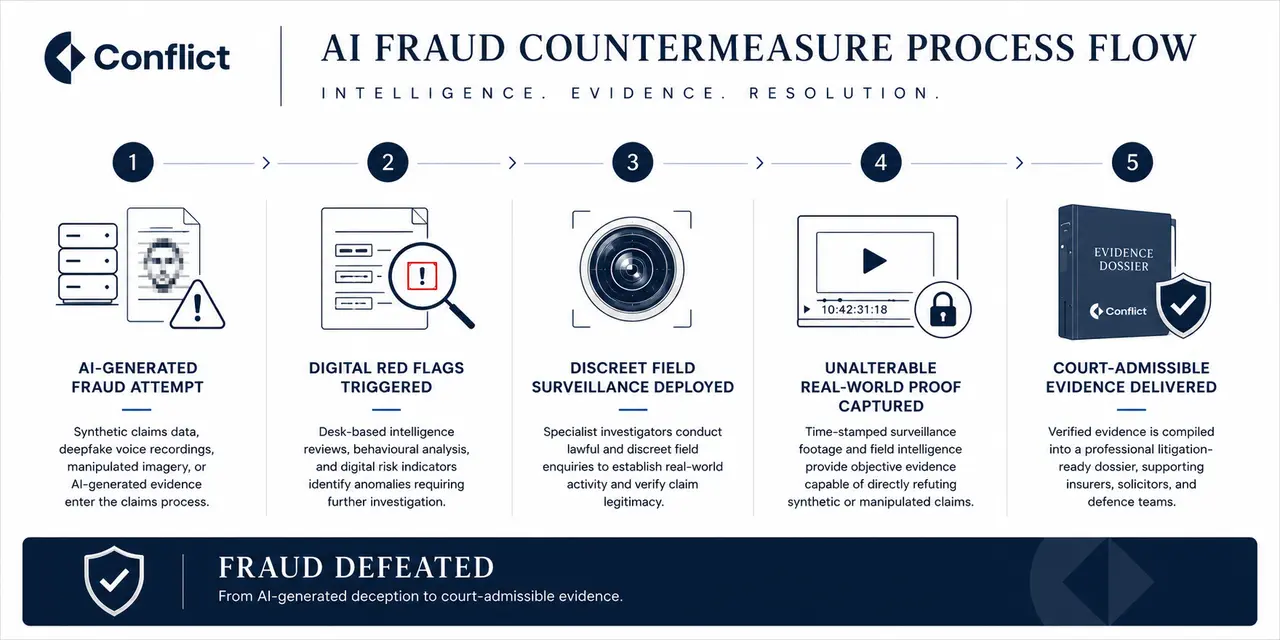
The Conflict International Operational Framework
As AI fraud models become more accessible, the volume of synthetic claims targeting high-net-worth portfolios and corporate insurers will continue to climb. Defending your enterprise requires a structured, process-driven transition from reactive analysis to active physical confirmation.
At Conflict International, we combine elite Open-Source Intelligence (OSINT) digital analysis with old-fashioned, highly trained boots on the ground. We don't guess based on a digital file; we verify through direct observation.
Our professional surveillance operatives deliver high-definition, legally obtained video and photographic evidence portfolios, backed by comprehensive logs compiled by experienced investigators. This provides your corporate legal counsel with the definitive, irrefutable evidence required to dismantle fraudulent claims, secure summary dismissals in court, and protect corporate profitability from the rising tide of synthetic cybercrime.
Are you confronting a high-value commercial claim that exhibits digital anomalies, or do you require discreet operational intelligence to protect your corporate assets? Contact Conflict International today to speak confidentially with our Global Surveillance and Corporate Risk Division.